
If you’re just setting out on your Integrated Reporting journey, here are some documents that should help you on your way.
What is an integrated report?
The Integrated Reporting Framework defines an integrated report as:
An integrated report is a concise communication about how an organization’s strategy, governance, performance and prospects, in the context of its external environment, lead to the creation of value over the short, medium and long term.
It’s a concise but complete report of business-critical information showing how an organisation creates, preserves and erodes value in the six forms of capitals that it uses and affects over the short, medium and long term in its business activities and selling its products and services. The integrated report draws on information contained in content-specific reports such as annual financial statements, sustainability report, and others.
Global best practice guidance
The Integrated Reporting Framework is used to prepare and present an integrated report in over 70 countries. It comprises 18 requirements that should be met in the content and format of a report. New reporters are allowed some flexibility in meeting all the requirements.
| Concepts | 8 Content Elements | 7 Guiding Principles |
|---|---|---|
|
Value creation, preservation or erosion |
Organisational overview & external environment | Strategic focus & future orientation |
• Reference the Integrated Reporting Framework • Comply with all 18 Requirements • Board responsibility statement |
Governance | Connectivity of information |
| Business model | Stakeholder relationships | |
| Risks & opportunities | Materiality | |
| Strategy & resource allocation | Conciseness | |
Form of the report • A designated, identifiable communication |
Performance | Reliability & completeness |
| Outlook | Consistency & comparability | |
| Basis of preparation & presentation |
Some history: The current version of the Integrated Reporting Framework was released in 2021 replacing the original version of 2013. The Integrated Reporting Framework is also known as the International <IR> Framework.
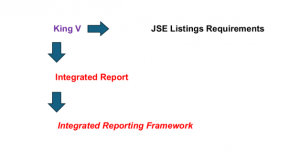
The Framework can be applied to suit your country’s local reporting needs and requirements. For instance, in South Africa, this would be the overarching corporate governance code, King V. The Framework can be used by organisations in the private sector, public sector and non-profit organisations.
Essential reading for new reporters
- Integrated Reporting Framework
- IRC Information Paper Preparing an Integrated Report – A Starter’s Guide (Updated) offers useful hints for preparing your integrated report.
- This information guide was re-launched by the IFRS Foundation, Transition to Integrated Reporting – A Guide to Getting Started, and sets out various routes to transitioning to integrated reporting that may be suited to different countries’ needs.
Practical informational guidance
The Information Papers and FAQs listed under “Guidance in South Africa” in our Guidance section offer explanations and practical implementation tips on the Content Elements and Guiding Principles of the Integrated Reporting Framework. To understand how the integrated report relates to the sustainability report and other report, see the three IRC Information Papers, A Comprehensive Global Corporate Reporting System, Integrated Reporting and Using a Approach to Layering Approach to Sustainability Reporting and Achieving a Concise Integrated Report.
Integrated Reporting in South Africa
Integrated reporting in South Africa should meet the requirements of the Integrated Reporting Framework as well as the principles and recommendations of the overarching King Codes of governance (the current iteration is King V).
Optional reading
(Note that some of these documents are dated from the inception of integrated reporting in 2012/13)
- The publication from the IFC and the Global Corporate Governance Forum “Integrated Reporting: Lessons from the South African Experience” provides insight into what contributes to effective integrated reporting
- What constitutes meaningful integrated reporting is answered in the article by CGF: “Why all organisations should publish a meaningful Integrated Report“
- ACCA’s publication titled “Insights into integrated reporting 3.0: The drive for authenticity”
- A guided journey into integrated reporting is provided by BDO in “Driving value creation through integrated thinking and reporting”
- Guidance from a CFO perspective is offered in this article by Chris Ruggeri, National managing principal at Deloitte transactions and business analytics: “Activism, guidance and purpose: The IR issues on the minds of CFOs“
- Guidance from a director’s perspective is offered in this publication by Deloitte: “A Directors’ guide to Integrated Reporting“
- The BCG article titled: “Ten Lessons from 20 Years of Value Creation Insights” and the practical how-to-guide by the UK Green Building Council: “Practical how-to guide: Implementing Integrated Reporting“